For Immediate Release
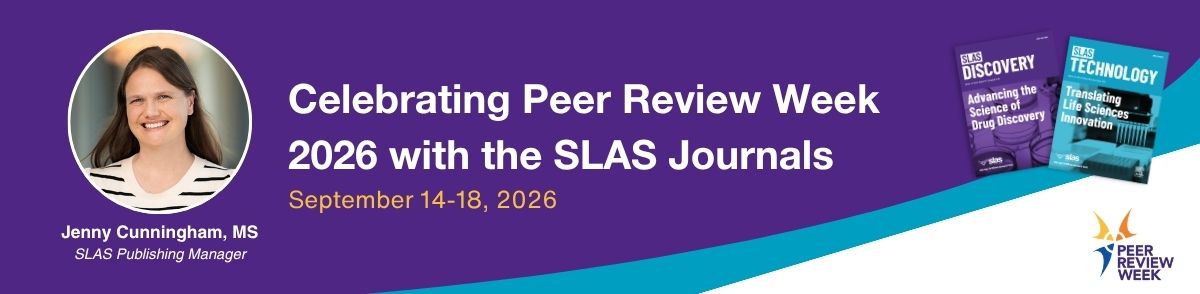
One of the things that makes SLAS unique is the way it brings industry and academia together. Our community includes scientists working across discovery and development alongside the people advancing the automation and screening technologies that make that work possible. A graduate student developing a new assay might find themselves swapping ideas with someone building the high-throughput platform that could eventually screen it at scale. Those kinds of exchanges happen across disciplines and career stages, bringing together people who might otherwise approach the same problem from entirely different directions.
That same collaborative spirit runs through SLAS Discovery and SLAS Technology. Our journals are inseparable from the broader scientific exchange that takes place across SLAS, and they depend on many of the same relationships. The expertise represented in the research we publish also shapes how that research is reviewed and strengthened. Much of that work is undertaken voluntarily by members of our community who serve as editors and reviewers.
That’s why Peer Review Week means so much to us. It’s a chance to recognize the hundreds of people who generously share their time and expertise with SLAS Discovery and SLAS Technology each year. Their contributions are at the heart of everything we do with these journals.
Over the past year, 379 reviewers from 53 countries have come together to evaluate 247 manuscripts across SLAS Discovery and SLAS Technology, completing 705 reviews along the way. For many, reviewing is something they fit in alongside their day jobs, their own research and their busy personal lives.
Their dedication and expertise benefit the entire scientific community. Only because reviewers are willing to devote their time and knowledge to the editorial process can we maintain the quality of what we publish and help researchers share their work. Their efforts do not go unnoticed.
This year’s Peer Review Week theme, “Peer Review Capacity: Volume, Speed, and Quality,” feels especially timely.
Submission volume has grown dramatically over the past few years. At SLAS Technology alone, the number of manuscripts crossing the Editor-in-Chief’s desk grew from just 74 in 2023 to 443 in 2024 and 576 in 2025—a nearly 680% increase in two years. That’s exciting growth, but each of those manuscripts needs the time and expertise of the editors and reviewers who make peer review work.
Across scholarly publishing, there’s a real crunch as more manuscripts compete for a finite pool of people with the right expertise. Authors expect (and deserve) timely decisions, but it’s not sustainable to keep going back to the same people again and again.
That’s the capacity challenge. We need to keep up with the growing volume of research and provide authors with prompt decisions while ensuring every manuscript receives a careful, rigorous review.
For us, part of the answer goes back to what SLAS has always been about, which is bringing people together to share what they know. The journals are one piece of a much larger community, and people don’t necessarily come to SLAS as authors or reviewers and stay in that one lane.
A student might present a poster at one of our conferences, connect with a mentor, and later publish their research with us. In fact, our 2025 Student Poster Award winner, Charissa Witters, PhD, recently did just that. Someone who first encounters SLAS through a conference may later review for one of our journals or join an editorial board. Peer review can be another entry point into the community, particularly for scientists who want to become more more engaged with emerging research in their field.
We’ve worked to create more of those pathways. Our Reviewer Bank lets scientists across the SLAS community volunteer to review and tell us where their expertise lies, so our editors have a broader pool of people to call on when a manuscript comes in.
We’ve also brought early-career scientists onto our editorial boards, where they collaborate with people with years of editorial and peer-review experience. We’ve seen some really wonderful mentor–mentee relationships develop as a result. Our experienced editors are teaching newer members what a useful review looks like and how editorial decisions get made, which prepares them to take on bigger roles in the journals over time.
That kind of mentorship is already deeply ingrained in SLAS. We see it in programs like Mentor Match at our conferences and in our journals. You’ll hear more about that tomorrow from SLAS Discovery Associate Editor Timothy Spicer, PhD, and his student Yuka Otsuka, PhD, who are sharing what they’ve learned from working together.
To us, building capacity means bringing more people into the process and giving them room to learn from one another.
Of course, having more reviewers to call on is only part of it. Our Editors-in-Chief, Robert Campbell, PhD, and Edward Kai-Hua Chow, PhD, along with our handling editors, have put a lot of work into keeping manuscripts moving by following up on overdue reviews and making prompt decisions once the reviews are in.
We’ve also worked with our publisher, Elsevier, on tools that make some of that work easier, including a new peer review experience in Editorial Manager that brings reviews and editor notes into a single view, along with integrity screening through Elsevier’s Check Integrity process.
The work is paying off. Even as the number of manuscripts submitted to our journals has grown, authors are receiving decisions faster. At SLAS Discovery, the median time to first decision has been cut by more than half since 2024, from 27 days to 13 days so far this year. The share of accepted papers reaching acceptance within 60 days has also more than tripled, climbing from 11% in 2024 to 38% in 2026. SLAS Technology has made major gains as well. Despite the extraordinary growth in manuscript volume, its median time to first decision has fallen by more than 60% since 2023 and remained under 20 days.
That work starts before a manuscript reaches peer review. As our journals continue to grow, we’re also looking for new ways to connect with researchers who may not yet know SLAS Discovery and SLAS Technology, or who may not see them as a home for their work. On September 23, we’re partnering with Elsevier to host a webinar for researchers across Asia, where editors from both journals will introduce our journals and discuss what they look for in a quality submission.
Building those connections matters throughout the publication process. When researchers understand our journals and their scope, it’s easier for them to see where their work fits. Manuscripts that arrive well matched and well prepared also tend to move through review more smoothly, which makes better use of our editors’ and reviewers’ time. Some of the researchers we connect with will eventually review and edit for us, too. As those connections grow, so does our capacity to keep building on the gains we’ve already seen.
What’s happening this week
We’ve asked editors, reviewers, and editorial board members from across the SLAS journals community to help us celebrate Peer Review Week, and you’ll be hearing from them throughout the week.
Monday, September 14: We’re kicking off the week with a new episode of the New Matter podcast with SLAS Scientific Director Madeline Farley, PhD, and our Editors-in-Chief, Robert Campbell, PhD, and Edward Kai-Hua Chow, PhD.
Tuesday, September 15: What makes a good review? SLAS Discovery Associate Editor Timothy Spicer, PhD, and his student Yuka Otsuka, PhD, a 2026 SLAS Reviewer Excellence Award winner, share the mentor–mentee perspective.
Wednesday, September 16: We’ll hear from the handling editor’s side of peer review, including how editors find the right reviewers beyond their usual networks.
Thursday, September 17: Members of our editorial board and reviewer community share the habits that help them review efficiently while giving authors useful feedback to improve their papers.
Friday, September 18: We’ll close the week by recognizing this year’s SLAS Journal Achievement Award winners for reviewer excellence.
If you’d like to become more involved with SLAS Discovery or SLAS Technology, we’d love to hear from you, whether you’re interested in reviewing, contributing an article, serving on an editorial board, or volunteering in another way.
To every reviewer who has said yes to an SLAS manuscript this year: thank you. We know this work takes time, and we know you’re fitting it in around plenty of other things. Your willingness to give that time and expertise is essential to our journals, and we are truly grateful.
With gratitude,
Jenny Cunningham, MS
Publishing Manager, SLAS
*****
SLAS (Society for Laboratory Automation and Screening) is an international professional society of academic, industry and government life sciences researchers and the developers and providers of laboratory automation technology. The SLAS mission is to bring together researchers in academia, industry and government to advance life sciences discovery and technology via education, knowledge exchange and global community building.
SLAS Discovery reports how scientists develop and use novel technologies and/or approaches to provide and characterize computational, chemical and biological tools to understand and treat human disease. The journal focuses on drug discovery sciences with a strong record of scientific rigor and impact, reporting on research that:
SLAS Technology reveals how scientists adapt technological advancements for life sciences exploration and experimentation in biomedical research and development. The journal emphasizes scientific and technical advances that enable and improve:
SLAS Discovery: Advancing the Science of Drug Discovery, 2024 Impact Factor 2.7. Editor-in-Chief Robert M. Campbell, Ph.D., Grove Biopharma, Inc., Chicago, IL (USA)
SLAS Technology: Translating Life Sciences Innovation, 2024 Impact Factor 3.7. Editor-in-Chief Edward Kai-Hua Chow, PhD, KYAN Technologies, Los Angeles, CA (USA).
###
Jill Hronek
Director of Marketing Communications
Telephone: +1.630.256.7527, ext. 103
E-Mail: jhronek@slas.org