For Immediate Release
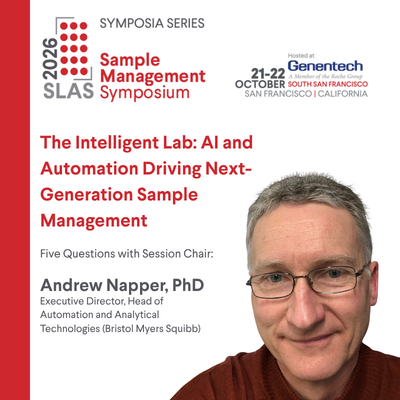
As part of our lead-up to the SLAS 2026 Sample Management Symposium hosted at Genentech, we’re speaking with each session chair to preview what attendees can expect from their session.
Andrew Napper, PhD, Executive Director, Head of Automation and Analytical Technologies (Bristol Myers Squibb), is chairing the session "The Intelligent Lab: AI and Automation Driving Next-Generation Sample Management."
This session will comprise short talks describing successes, challenges, and future opportunities applying AI/ML models and applications to sample inventory management, logistics, and workflows.
We asked Napper to share the inspiration for this session, its importance to the sample management community, and what tangible takeaway attendees will leave with.
Napper: Much has been presented on AI orchestration of Design-Make-Test-Analyze (DMTA) cycles. However, there is less discussion of the paradigm shift in sample management that may accompany the transition to AI-driven, autonomous, closed-loop lab operations. There are exciting possibilities for dynamic inventory monitoring and distribution, but significant technological and organizational challenges ahead to reach an ideal future state. The SLAS Sample Management Symposium is an ideal forum for industry experts to describe their approaches to address these challenges, and share successes to date, remaining roadblocks, and perspectives for the future.
Napper: AI orchestration of inventory management and automated sample storage and distribution promises seamless data-driven matching of sample supply and availability to testing schedules. The changes needed for this to be successful will be as much organizational as technological. Therefore, the sample management community needs to ensure that teams are structured appropriately and team members are empowered with relevant skills and experience.
Napper: A critical mistake to avoid is expecting AI/ML to compensate for inefficient workflows and unstructured data. AI/ML models need to be trained on consistent and well-curated data, and deployed in conjunction with well-designed processes and operations.
Napper: I expect sample management to be more closely orchestrated with automated synthesis, testing and data analysis. Sample amount and location will be aligned dynamically with data-driven test design and scheduling. Sample management operations will evolve from a stand-alone operation to embedded processes in orchestrated cross-functional drug discovery.
Napper: That a paradigm shift is underway, but the route to an ideal future state is still to be completely defined and requires significant technological and organizational change.
Register now for the SLAS 2026 Sample Management Symposium hosted at Genentech, October 21-22, 2026. This session and more will dive deeper into current trends and new developments shaping sample management.
*****
SLAS (Society for Laboratory Automation and Screening) is an international professional society of academic, industry and government life sciences researchers and the developers and providers of laboratory automation technology. The SLAS mission is to bring together researchers in academia, industry and government to advance life sciences discovery and technology via education, knowledge exchange and global community building.
###
Jill Hronek
Director of Marketing Communications
Telephone: +1.630.256.7527, ext. 103
E-Mail: jhronek@slas.org