For Immediate Release
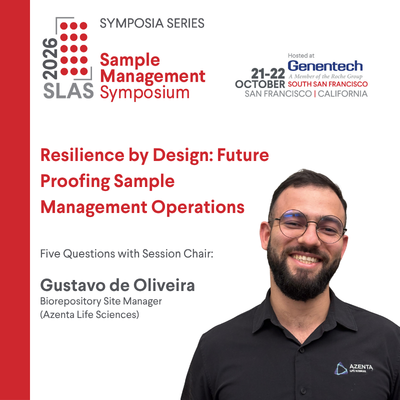
As part of our lead-up to the SLAS 2026 Sample Management Symposium hosted at Genentech, we’re speaking with each session chair to preview what attendees can expect from their session.
Gustavo de Oliveira, Biorepository Site Manager (Azenta Life Sciences), is chairing the session "Resilience by Design: Future Proofing Sample Management Operations."
This session will explore how organizations can design resilient sample management operations to withstand disruption, ensure compliance, and support long-term growth.
We asked Oliveira to share the inspiration for this session, its importance to the sample management community, and what tangible takeaway attendees will leave with.
Oliveira: That is what I live and breathe every day. I help people improve their sample management practices. What better way to help the community than by bringing together leaders from different industries to discuss how they have been advancing their sample management operations? That way, everyone can learn from different scales and implement ideas in their organizations.
Oliveira: Cold storage grows at a 10% rate every year. Today, 16% to 26% of research lab space is used for cold storage units. We need to plan for sample inventory growth and management over time during early phases of a project, new facility buildouts, or new acquisitions.
Oliveira: Sample management is typically an afterthought in facility design. You can greatly reduce the footprint required for cold storage by using a use-based approach that keeps materials easily accessible near the bench while maximizing sample density in shared resource areas. Clear governance, access controls and business continuity plans provide greater visibility into our institution’s most precious assets after our employees: the samples that form the foundation of all scientific questions and discoveries. Planning for cold storage growth enables proper sample management, keeping material safe from excursions and monitored.
Oliveira: Sample management will continue to evolve toward greater visibility, control, and automation across the entire sample lifecycle. A key enabler of this transformation will be increased standardization. While no single approach will meet every organization’s needs, greater alignment around standardized labware, processes, and data structures will help organizations achieve higher storage densities, improve automation, strengthen cold chain integrity, and enhance the quality and reliability of both samples and the data generated from them.
We are already seeing this transition in small molecule and compound management, where standardized labware has enabled significant gains in efficiency and automation. I expect similar advances to expand across biologics, clinical, and translational research repositories over the next several years.
Equally important, I want sample management to be a strategic consideration at the outset of every research program, facility design, and acquisition. Too often, organizations address sample management only after challenges emerge. Organizations that incorporate sample management planning early can improve operational efficiency, reduce risk, protect valuable materials, and generate higher-quality scientific outcomes.
Oliveira: I want attendees to find ways to influence their organizations to bring sample management to the beginning of each project, each new facility build-out, and each new acquisition. We need a plan for all samples and materials we will manage throughout a project’s lifecycle, including when we inherit new material.
Register now for the SLAS 2026 Sample Management Symposium hosted at Genentech, October 21-22, 2026. This session and more will dive deeper into current trends and new developments shaping sample management.
*****
SLAS (Society for Laboratory Automation and Screening) is an international professional society of academic, industry and government life sciences researchers and the developers and providers of laboratory automation technology. The SLAS mission is to bring together researchers in academia, industry and government to advance life sciences discovery and technology via education, knowledge exchange and global community building.
###
Jill Hronek
Director of Marketing Communications
Telephone: +1.630.256.7527, ext. 103
E-Mail: jhronek@slas.org