For Immediate Release
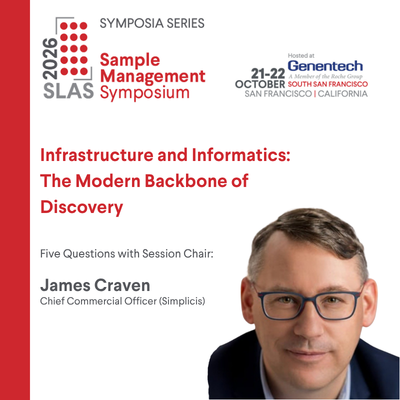
As part of our lead-up to the SLAS 2026 Sample Management Symposium hosted at Genentech, we’re speaking with each session chair to preview what attendees can expect from their session.
James Craven, Chief Commercial Officer (Simplicis), is chairing the session "Infrastructure and Informatics: The Modern Backbone of Discovery."
This session will examine how research organizations — from large pharmaceutical companies to lean biotechs — build and sustain the informatics and IT infrastructure that powers scientific discovery.
We asked Craven to share the inspiration for this session, its importance to the sample management community, and what tangible takeaway attendees will leave with.
Craven: Having worked in sample and compound management for more than 20 years, I've seen the technology change enormously, but many of the challenges we talk about haven't changed nearly as much. The session really came from wanting to look beyond individual systems and instruments and ask whether the infrastructure we're building today is actually ready for where discovery is going.
Craven: Sample management isn't just about storing material and fulfilling requests anymore. We're increasingly connecting scientists, automation, inventory, data and external partners, and if those connections don't work well, they can quickly become a constraint on the science. That makes this an important time for the sample management community.
Craven: One of the biggest mistakes I've seen is designing a database around how you work today, or around a specific piece of automation. Workflows change, organizations change, and technologies change. If you don't think from the beginning about how that database will connect to other systems and adapt as things change, it's very easy to spend a lot of time and money creating another silo.
Craven: I expect AI and increasingly autonomous laboratories to significantly impact sample management, but we're not truly ready for that yet. We still have too much critical information sitting across different databases, spreadsheets and instruments, and sometimes simply in people's heads. If AI and autonomous laboratories are going to work reliably, we need to get much better at connecting that information and making sure the underlying data has the context and quality needed to trust it.
Craven: I want people to step back from individual software systems, instruments or applications and think about how everything fits together. We shouldn't just use new technology to automate what we've always done. We should be asking whether there's a better way to connect samples, data, scientists and automation in the first place.
I'm particularly looking forward to hearing the different perspectives in the session. There's an enormous amount of experience in the sample management community, but we also need to be prepared to challenge some of the assumptions we've carried with us for years. The environment we're supporting is changing quickly, and some approaches that worked for us 10 or 20 years ago may not suit what's coming next.
Register now for the SLAS 2026 Sample Management Symposium hosted at Genentech, October 21-22, 2026. This session and more will dive deeper into current trends and new developments shaping sample management.
*****
SLAS (Society for Laboratory Automation and Screening) is an international professional society of academic, industry and government life sciences researchers and the developers and providers of laboratory automation technology. The SLAS mission is to bring together researchers in academia, industry and government to advance life sciences discovery and technology via education, knowledge exchange and global community building.
###
Jill Hronek
Director of Marketing Communications
Telephone: +1.630.256.7527, ext. 103
E-Mail: jhronek@slas.org