For Immediate Release
Peer review is often described as the backbone of scientific publishing. Yet many students and early-career researchers’ experience is as authors, not as reviewers.
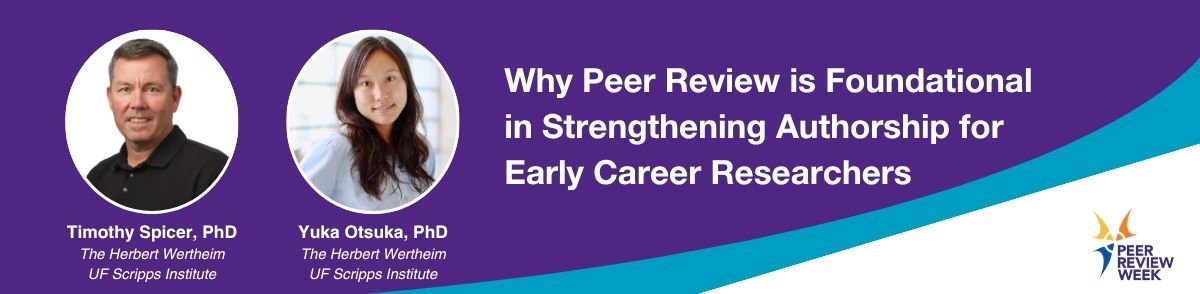
SLAS Discovery Associate Editor Timothy Spicer, PhD (The Herbert Wertheim UF Scripps Institute), and Yuka Otsuka, PhD (The Herbert Wertheim UF Scripps Institute), provide insight into how introducing students to peer review early in their careers can sharpen their scientific writing, build their confidence, and strengthen authorship as the next generation of researchers. From practical guidance on completing a first review to the unique role SLAS plays in fostering the next generation of reviewers, this conversation offers valuable insights for mentors, journals and early career scientists.
Read — Spicer and Otsuka also recently collaborated on the SLAS Discovery article, “Identification of Potent Small Molecule Inhibitors of SARS-CoV-2 Entry,” offering a firsthand example of the collaborative relationships that can help researchers grow as scientists and authors.
Spicer & Otsuka: We introduce peer review to students and early-career researchers as a way to see how other labs design studies, conduct research and present their work efficiently and logically. In addition to being exposed to discoveries, technologies and results, trainees also learn the basic rules of publication and more effective ways to present their work and new ideas.
Spicer & Otsuka: Evaluating someone else’s manuscripts will train early career researchers to focus on the accuracy of the work they are reviewing, understand the needs of the reader, identify gaps in the work or writing, and build on their own language skills and debating strategies. It also helps them be fair and unbiased in their reviews, demonstrating leadership at a young age.
Spicer & Otsuka: I shared examples of my prior reviews with “first time” reviewers, along with a clear explanation of the review process and what makes a review helpful and successful for the submitting authors. I also described how to determine what modifications are required and why they are critical. For the first round or two, I also read each reviewer’s first review and gave direct feedback.
Spicer & Otsuka: I see their confidence grow with this experience, and they are typically willing to do more reviews, which exposes them more deeply to the research community while advancing their careers. They also become faster at reviews, making them more effective as publishing researchers, all good all around!
Spicer & Otsuka: It is critical to provide opportunities and early guidance as an early-career reviewer begins the process. It’s about giving them the opportunity and building their confidence in the process, while ensuring their initial reviews are fair and constructive.
Spicer & Otsuka: SLAS brings academic and industry professionals together. The same is true for the journals. It is an entirely volunteer-based review process that spreads the need for qualified reviewers, increasing opportunities for early-career scientists to participate. SLAS is also the perfect place to explore new biology and technologies, which are often different from what someone with a large research program will publish. Early career scientists are generally far more comfortable with novelty and technology escalation, definitely more so than senior scientists, so that is another key reason for SLAS to become their home.
*****
SLAS (Society for Laboratory Automation and Screening) is an international professional society of academic, industry and government life sciences researchers and the developers and providers of laboratory automation technology. The SLAS mission is to bring together researchers in academia, industry and government to advance life sciences discovery and technology via education, knowledge exchange and global community building.
SLAS Discovery reports how scientists develop and use novel technologies and/or approaches to provide and characterize computational, chemical and biological tools to understand and treat human disease. The journal focuses on drug discovery sciences with a strong record of scientific rigor and impact, reporting on research that:
SLAS Technology reveals how scientists adapt technological advancements for life sciences exploration and experimentation in biomedical research and development. The journal emphasizes scientific and technical advances that enable and improve:
SLAS Discovery: Advancing the Science of Drug Discovery, 2024 Impact Factor 2.7. Editor-in-Chief Robert M. Campbell, Ph.D., Grove Biopharma, Inc., Chicago, IL (USA)
SLAS Technology: Translating Life Sciences Innovation, 2024 Impact Factor 3.7. Editor-in-Chief Edward Kai-Hua Chow, PhD, KYAN Technologies, Los Angeles, CA (USA).
###
Jill Hronek
Director of Marketing Communications
Telephone: +1.630.256.7527, ext. 103
E-Mail: jhronek@slas.org