For Immediate Release
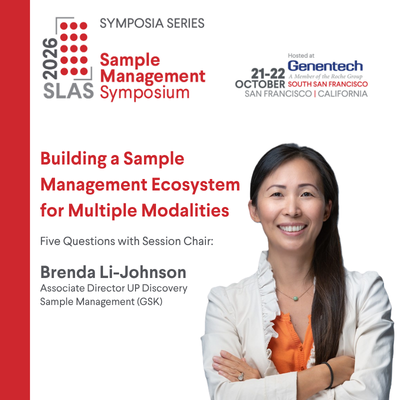
As part of our lead-up to the SLAS 2026 Sample Management Symposium hosted at Genentech, we’re speaking with each session chair to preview what attendees can expect from their session.
Brenda Li-Johnson, Director, US Sample Management (GSK), is chairing the session "Building a Sample Management Ecosystem for Multiple Modalities." This session will explore the critical aspects of establishing a robust sample management framework capable of integrating diverse research areas.
We asked Li-Johnson to share the inspiration for this session, its importance to the sample management community, and what tangible takeaway attendees will leave with.
Li-Johnson: The inspiration came from seeing organizations repeatedly struggle with the same challenge: as research portfolios expand across modalities like small molecules, oligonucleotides, biologics, cell lines, and proteins, sample management systems built for one modality don't scale to the others. We wanted to create a space to discuss how to build a framework flexible enough to handle these distinct handling and data requirements without fragmenting into disconnected silos.
Li-Johnson: As research organizations increasingly pursue multi-modality pipelines, sample management can no longer be an afterthought handled modality-by-modality. Without a unified approach, teams face duplicated infrastructure, inconsistent data, and slower handoffs between discovery and downstream processes. Getting this right directly impacts how quickly and reliably an organization can move from sample to insight.
Li-Johnson: A common misconception is that a system designed for one modality, such as small molecules, can simply be extended to cover biotherapeutics or cell lines with minor tweaks. In reality, each modality carries distinct handling, storage, and data requirements, and treating them as interchangeable often leads to costly rework later. Organizations frequently underestimate the upfront effort and cost needed for true data harmonization across disparate systems.
Li-Johnson: We expect sample management to move toward increasingly unified ecosystems where data capture, transfer, and harmonization happen seamlessly across modalities rather than through manual reconciliation. This will be driven by growing pressure to accelerate discovery timelines and leverage data more strategically across research areas. Organizations that invest now in flexible, integration-ready architectures will be best positioned to adapt as new modalities emerge.
Li-Johnson: Attendees should leave with practical strategies for designing a sample management framework that accommodates diverse modalities without sacrificing efficiency or data integrity. The goal is for them to see that integration across modalities isn't just a technical challenge, but a strategic opportunity to accelerate discovery. This session is meant to be a candid, practical conversation, not a theoretical one. We hope attendees bring their own challenges to discuss, since some of the best insights will come from the shared experiences in the room.
Register now for the SLAS 2026 Sample Management Symposium hosted at Genentech, October 21-22, 2026. This session and more will dive deeper into current trends and new developments shaping sample management.
*****
SLAS (Society for Laboratory Automation and Screening) is an international professional society of academic, industry and government life sciences researchers and the developers and providers of laboratory automation technology. The SLAS mission is to bring together researchers in academia, industry and government to advance life sciences discovery and technology via education, knowledge exchange and global community building.
###
Jill Hronek
Director of Marketing Communications
Telephone: +1.630.256.7527, ext. 103
E-Mail: jhronek@slas.org