For Immediate Release
As part of our lead-up to the SLAS 2026 Sample Management Symposium hosted at Genentech, we’re speaking with each session chair to preview what attendees can expect from their session.
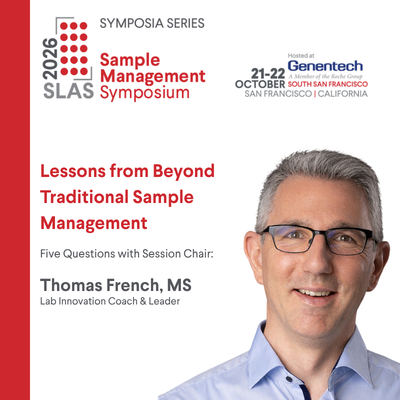
Thomas French, MS, is chairing the session "Lessons from Beyond Traditional Sample Management."
This session will share best practices from applications, including GxP laboratories, diagnostics, forensics, product development and agriculture. Additionally, it will highlight approaches to sample traceability, regulatory compliance and efficient lifecycle management.
We asked French to share the inspiration for this session, its importance to the sample management community, and what tangible takeaway attendees will leave with.
French: When visiting sample management labs, especially non-traditional ones, there is always something new to discover. A common statement I hear is: “We had to do something different because the way everyone else is doing it is not working in our lab.” Some of these challenges and solutions appear unique at first but over time may evolve into transferable practices that can benefit the wider community. I am excited that three speakers will share their specific applications, including cell, blood, and forensic samples, along with their challenges and practices with the broader community this fall.
French: Sample management challenges are approached differently across and within life science industry segments, and some areas have developed highly creative solutions to store, process, and deliver samples effectively. While certain approaches are highly application-specific, many underlying principles can inspire improvements in more traditional sample management environments too. Looking at the bigger picture, it is about managing samples, and many applications appear similar; looking closer, the functional and non-functional requirements can differ significantly. For some, equipment reliability is the key factor, while others may rely on throughput, accessibility, or quality. Sharing these perspectives encourages the community to look beyond established implementations and explore new possibilities.
French: A common misconception is that a solution that works well in one environment can simply be replicated elsewhere. When adopting solutions that implement best practices, it is common for organizations to “patch” them into an existing lab environment, creating additional workarounds to “use it too.” Instead of following the hype and adopting something because it appears innovative, exciting, or just the default, labs should first understand the underlying need it addresses and evaluate whether the approach and practices make their lab more resilient and align with their workflows, objectives, and constraints before investing in a new tool or solution.
French: In many organizations, sample management is the backbone of their research activities. Technological advancements such as physical AI, automated synthesis, scientific breakthroughs, regulatory constraints, and evolving business models will continue to drive change and require sample management labs to adapt. Organizations must implement these changes while teams continue to receive samples and fulfill orders. The question is not whether change is coming, but how teams can build resilience to respond to it successfully rather than be negatively impacted by it—avoiding a ripple effect on the rest of the organization.
French: The goal is to instill curiosity and out-of-the-box thinking in attendees about what sample management can become by presenting different sample management applications. These takeaways will equip attendees with new perspectives on how to improve their own operations, processes or tools. I am excited to be back at an SLAS-organized Sample Management Symposium this fall. I look forward to reconnecting with the community and continuing the conversation around innovation in sample management. Thank you to SLAS for providing a platform and a home for this community.
Register now for the SLAS 2026 Sample Management Symposium hosted at Genentech, October 21-22, 2026. This session and more will dive deeper into current trends and new developments shaping sample management.
*****
SLAS (Society for Laboratory Automation and Screening) is an international professional society of academic, industry and government life sciences researchers and the developers and providers of laboratory automation technology. The SLAS mission is to bring together researchers in academia, industry and government to advance life sciences discovery and technology via education, knowledge exchange and global community building.
###
Jill Hronek
Director of Marketing Communications
Telephone: +1.630.256.7527, ext. 103
E-Mail: jhronek@slas.org